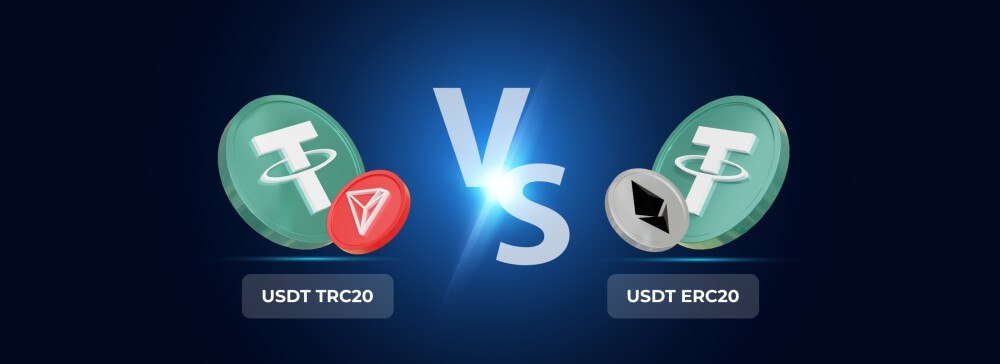
Topping up the SWT Card with USDT cryptocurrency is a common and practical way to quickly add funds to your account for future spending. Two key blockchain networks are most commonly used for USDT transfers: ERC20, which operates on the Ethereum platform, and TRC20, based on the Tron network. Each of these networks has its own characteristics that directly influence a user's choice: processing speed, fee size and structure, and the level of support by various services and wallets.
What are USDT, ERC20, and TRC20: Key Differences
USDT (Tether) is a stablecoin, a digital token pegged to the US dollar at a 1:1 ratio. It is used for fast and stable fund transfers between exchanges and electronic wallets. Due to its stability, USDT is popular among traders and investors in the cryptocurrency market.
The main and most fundamental difference between USDT ERC20 and USDT TRC20 is the blockchain platform on which these tokens operate. This affects many technical and user characteristics: transaction fees, processing speed, level of decentralization, and network reliability.
USDT ERC20 is an ERC20 standard token on the Ethereum network. Ethereum is one of the first and most widely known platforms for creating smart contracts and decentralized applications, and therefore attracts a huge number of users, developers, and projects. Due to its high popularity, the Ethereum network is often congested, leading to transaction queues and spikes in fees. Currently, the fee range is even more variable: during quiet periods, a transfer on the Ethereum network is often cheaper than on Tron (TRC20), while during peak loads, the fee can still rise sharply. In rare cases, it still reaches tens of dollars, but this is not the norm and depends on the time of day and mempool congestion. Transaction confirmation time on the Ethereum network can range from a few minutes to half an hour or even more during particularly high congestion. The main advantages of Ethereum are high operational reliability, a long history of stable performance, active development, and constant attention from security specialists. The network has a high degree of decentralization: a large number of independent nodes, distributed security measures, and frequent internal and external audits. This ensures resilience against hacks and technical failures. However, due to the scale and openness of the Ethereum ecosystem, users are advised to be extremely careful when following external links, confirming access to new smart contracts, and safeguarding their private keys.
USDT TRC20, unlike ERC20, runs on the Tron blockchain, which uses its own version of a token standard. The main advantage of the Tron network is high throughput and minimal transaction fees. USDT TRC20 transfers are almost always carried out in seconds or, at most, a few minutes—even if many other transfers are being processed at the same time. However, under current conditions, TRC20 fees can fluctuate: on normal days they remain low, but they often reach several dollars and, in some cases, around $10 per transfer. This efficiency is achieved through the unique architecture of the Tron blockchain, which uses fewer independent validators compared to Ethereum. This speeds up transaction processing and reduces commission fees, but at the same time decreases the degree of decentralization. On one hand, Tron is considered a fairly reliable platform with modern cryptographic protection of user data, regular technical updates, and a high level of support. On the other hand, experts sometimes express concerns that less decentralization could make the network more vulnerable to coordinated attacks or emergency situations.
Main Payment Errors
When paying with ERC20 and TRC20, users often make typical mistakes that can lead to loss of funds or payment delays. One of the most common errors is forgetting that the transfer fee is charged not in the ERC20 or TRC20 token itself, but in the base currency of the respective blockchain. For the Ethereum network (ERC20), the fee is paid in ETH, and for the Tron network (TRC20), it is paid in TRX.
Sometimes senders top up a wallet only with the required amount of tokens for payment, completely ignoring the fact that they need to have at least a small amount of ETH or TRX on the balance to cover fees. As a result, the transaction hangs, the transfer does not go through, the user loses time, and in rare cases, funds—if the transfer was made to an exchange that does not return erroneously sent tokens.
Another frequent error is choosing the wrong network when transferring tokens, especially if the receiving side supports only one of them. Sending ERC20 tokens to a TRC20 address (or vice versa) usually leads to loss of access to funds, especially if the address belongs to an exchange.
But these errors are usually easy to prevent: always check the fee requirements, keep a small reserve of ETH or TRX in your account in advance, and carefully select the correct network and address for sending.
Practical Tips for Topping Up the SWT Card
When topping up the SWT Card using ERC20 or TRC20 tokens, it is important to exercise caution and follow proven recommendations.
One of the best practical tips is to always start with a test transaction for a minimum amount, for example, $10 (which is the minimum allowable top-up amount). This will ensure that you have entered the address correctly, selected the right network, and calculated the fees accurately.
A test transaction helps avoid the loss of large amounts due to potential errors, such as an incorrectly selected network standard or a typo in the recipient's address. Moreover, you can check the payment processing time and the correctness of the funds being credited specifically to your card. Once you are sure that the top-up was successful, you can transfer a larger amount.
Be sure to keep a small reserve of ETH or TRX to pay fees, and before each transfer, carefully check the details and the selected network to minimize the risk of errors and keep your funds safe.
When choosing a network to top up your SWT Card for daily payments, you should aim for a balance between speed, fee cost, and reliability level. If low fees and high transaction speed are important to you, the TRC20 network is often the optimal choice. However, if your priority is broad support by exchanges and services, as well as additional security, it makes sense to consider the ERC20 network, despite the higher fees.
In any case, before topping up, it is important to thoroughly check the selected network, the accuracy of the entered data, and the terms of the SWT Card platform itself. Such a responsible approach will ensure a fast, convenient, and secure top-up of your card for everyday payments.
💰 More about cryptocurrency in the SWT Telegram channel 💰
Free
card service for all new users


Share